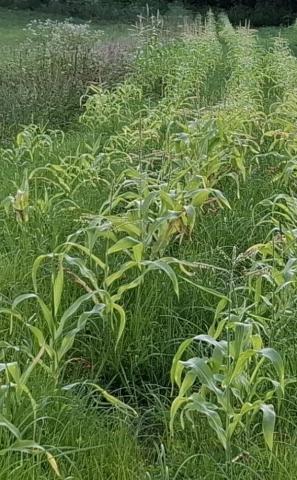
The First and Last Corn Crop of Triple "5" Farms
We had the rows. Beautiful rows. Freshly tilled, hilled, fertilized — everything looked the way it was supposed to. But what we didn’t realize at the time was that growing corn, especially organically, is not as simple as dropping seed in good dirt and waiting for the cobs to come rolling in.
The Misunderstood Crop
I used to think corn was just a plant — you water it, you feed it, it grows. But the truth is, corn is not just a plant. It’s a product of human interference going back over 9,000 years. Originally a wild grass called *teosinte* native to Mesoamerica, corn was cultivated over millennia to become the high-yielding, high-input hybrid we plant today. And even heritage varieties, grown without modification, expect intervention — pesticides, herbicides, mold inhibitors. It's baked into their biology now.
I also misunderstood the plant itself. I thought corn stalks made multiple ears. Turns out, most modern corn stalks produce just one primary ear. Two if you’re lucky and conditions are perfect. Any more than that, and it’s an outlier — not the rule.
The Race Between Corn and Grass
As our corn started to come up, it looked promising. Until the hayfield woke up. The same nutrients we’d pumped into the rows woke up the entire field. For the first three feet of growth, it was a footrace between the corn and a lush new hay crop that had no intention of being left behind.
No one told me about cultivation. I didn’t even know what that word meant in the context of row crops. I thought corn would just... win. But it didn’t. The grass rose, the weeds came, and the minerals were stripped out of the topsoil. The corn turned yellow.
Trying to Do It by the Book
I had a nitrogen schedule. I had a plan. I thought the yellowing meant it was thirsty. So I watered it — a little too much. That opened the door for mold, mildew, and rot. The plants went soft. The calendar said “fertilize again.” The field said “don’t bother.”
The few cobs that did develop were snatched up by deer and raccoons. What was left behind was a shriveled, stunted, fungal disaster — yellow leaves, broken stalks, and enough loss to teach a lesson I won’t forget.
The End of the Row
I hooked up the sickle mower. Fired up the old tractor. And with a strange mix of disappointment and smug satisfaction, I dropped the blade into the dying corn and began mowing down what remained of our first and final corn crop. Over $600 in fertilizer, seed, and fuel — gone. And that doesn’t even account for the time. The hours. The hope.
I didn’t compost it. I didn’t cry over it. I tilled it up, piled it high, and trucked it to the goats — the green machines. They loved it. And honestly, that was probably the best possible outcome.
Final Thoughts
This wasn’t just a failed crop — it was an education. Corn taught us about soil, balance, timing, and intervention. It taught us that even when it looks perfect, it probably isn’t. And that sometimes, the best harvest you’ll get is the one where you learn what not to do again.
The corn didn’t feed the farm, but it fed the goats — and the next time we plant something, we’ll know better.
Field Notes and Search Focus
We keep this guide practical for folks running real farms. The focus here is farm fencing and infrastructure systems, with clear steps and neighbor-tested lessons from day-to-day work. 🌱
Related Topics We Cover
farm fence planning, water line layout, shelter placement, pasture lane design, low cost farm build.
Questions Folks Ask Us
- how to design fencing for mixed livestock farms
- best farm water system layout for 20 acre properties
- where to place shelters for wind and drainage on pasture
- budget farm infrastructure plan for new homesteads
- common farm fencing mistakes and how to avoid them
Related Farm Guides
- See our guide on 12
- See our guide on 13
- See our guide on 14
- Read the full cornerstone guide for this topic cluster
FAQ
How to design fencing for mixed livestock farms?
Start with a phased setup, validate in field conditions, and document maintenance as you go. That approach keeps farm fencing and infrastructure systems reliable and easier to scale.
Best farm water system layout for 20 acre properties?
Start with a phased setup, validate in field conditions, and document maintenance as you go. That approach keeps farm fencing and infrastructure systems reliable and easier to scale.
Where to place shelters for wind and drainage on pasture?
Start with a phased setup, validate in field conditions, and document maintenance as you go. That approach keeps farm fencing and infrastructure systems reliable and easier to scale.
Budget farm infrastructure plan for new homesteads?
Start with a phased setup, validate in field conditions, and document maintenance as you go. That approach keeps farm fencing and infrastructure systems reliable and easier to scale.
Common farm fencing mistakes and how to avoid them?
Start with a phased setup, validate in field conditions, and document maintenance as you go. That approach keeps farm fencing and infrastructure systems reliable and easier to scale.
How much should we budget before starting?
Use phased budgeting with a contingency buffer. Focus first on reliability, then optimize performance after baseline stability is proven.
Comments