Planting Season 2024 – Breaking Ground, Breaking Equipment, and Breaking In
Spring 2024 is shaping up to be our first real trial run in turning worked earth into harvestable rows — and it’s already proving that “simple” isn’t a word that applies to farming.
First, There Was Dirt
Long before planting ever begins, you have to prepare the ground — a task that sounds easy enough until you’re staring at a field that hasn’t seen more than a hay rake in decades. We knew we wanted hills, we knew we needed valleys, and we knew… well, not much else. With no clue what row planting even required, we started assembling a Frankenstein lineup of equipment — beginning with a used tractor that came with a single bottom plow. That was the seed.
From there: a disc harrow, a tine harrow (useless), and eventually, a rototiller. In November, with little more than determination and a heap of cussing, we took the plow to the field. Clutch drops, stalls, and starter cranks later, we had a rough first pass — and by January, we’d plowed north-south, then east-west, and finally diagonally just to say we did. By February, the disc had been run. Clods were broken. The dirt was “done,” or so we thought.
The Tiller... Sort Of
Next came the tiller. The PTO turned, but the tines didn’t. After some plier-based tinkering, we discovered it had a transmission — a mystery to the previous owner and a jump scare to us when it finally clicked into gear. Turns out, it only liked to turn one way. The other way killed the tractor.
Once sorted, we limped along at one inch per pass, fuel burn soaring, until after 15 gallons of gas we had worked maybe 4 inches deep into the hard clay soil. This wasn’t just dirt — it was summer-baked hardpan and winter-saturated hydrolated mess. Something had to give.
Calling in Reinforcements
Neighbor Pete offered help, and with his diesel, we were able to cut down into the soil nearly 18 inches. That’s when the rain came. And with it, the revelation that the ground had a slope… and that slope led water — and all our loose soil — directly to a low-lying culvert we didn’t know existed. What we had created was no longer a field. It was a sediment trap and an accidental creek bed.
Retrying and Rebuilding
Time for a second favor: this time from Shane and his big-wheel Ford 3000. With better grip and more weight, we tilled it all again, trying to average out the creek into something resembling a planting surface. Then came the homemade hiller frame — built from I-beams and roof tin, bolted to the tiller, and capable of carving out some of the best planting rows we’d seen yet. And then… we bought a planter. And a cone spreader. Why not?
Fertilizer, Tillage, and Tired Arms
We prepped with 0-0-43, waited, tilled again, followed with 0-30-0, and capped it off with 40-0-0. Then we hooked the hiller back up and formed crisp rows. For a brief, shining moment, it looked like we knew what we were doing. And then it was time to plant.
Corn... by Pipe
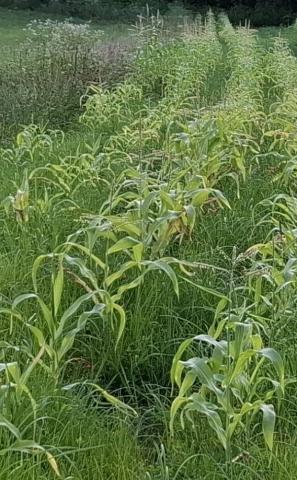
At this point, the planter wasn’t ready. So we tried the PVC pipe method — one seed, one stick mark at a time. After a single row, it was clear this would never happen again. Hands were stained, patience lost. That’s when Emily and Rick showed up and helped finish the 8 rows of corn by hand. A true community effort — with a touch of stubborn madness.
Fixing the Planter, Planting the Rest
Determined never to use the pipe again, we tuned the planter and got it running. For the purple hull peas, we dusted the seeds with Myco Bliss — which clumped up when wet — and jammed it all into the hopper. The rows were uneven, so we just made multiple passes until they looked decent. Aiming for four rows, we got eight. Same deal with the provider beans and sugar snap peas.
Problem was: the planter flattened all our pretty hills. So much for form. But in the end, beans, peas, and corn went in the ground. All that’s left now is to wait — and hope the rain stays on the good side of the field.
Summary
Planting Season 2024 isn’t just about crops. It’s about learning the land, the machines, the weather, and ourselves. Mistakes were made. Equipment was cussed. But the rows are in — and for now, that’s enough.
Triple "5" Farms — Spring 2024: One tractor, too many attempts, and a whole lot of seed in the dirt. Let’s see what grows.
Field Notes and Search Focus
We keep this guide practical for folks running real farms. The focus here is farm fencing and infrastructure systems, with clear steps and neighbor-tested lessons from day-to-day work. 🌱
Related Topics We Cover
farm fence planning, water line layout, shelter placement, pasture lane design, low cost farm build.
Questions Folks Ask Us
- how to design fencing for mixed livestock farms
- best farm water system layout for 20 acre properties
- where to place shelters for wind and drainage on pasture
- budget farm infrastructure plan for new homesteads
- common farm fencing mistakes and how to avoid them
Related Farm Guides
- See our guide on 12
- See our guide on 13
- See our guide on 14
- Read the full cornerstone guide for this topic cluster
FAQ
How to design fencing for mixed livestock farms?
Start with a phased setup, validate in field conditions, and document maintenance as you go. That approach keeps farm fencing and infrastructure systems reliable and easier to scale.
Best farm water system layout for 20 acre properties?
Start with a phased setup, validate in field conditions, and document maintenance as you go. That approach keeps farm fencing and infrastructure systems reliable and easier to scale.
Where to place shelters for wind and drainage on pasture?
Start with a phased setup, validate in field conditions, and document maintenance as you go. That approach keeps farm fencing and infrastructure systems reliable and easier to scale.
Budget farm infrastructure plan for new homesteads?
Start with a phased setup, validate in field conditions, and document maintenance as you go. That approach keeps farm fencing and infrastructure systems reliable and easier to scale.
Common farm fencing mistakes and how to avoid them?
Start with a phased setup, validate in field conditions, and document maintenance as you go. That approach keeps farm fencing and infrastructure systems reliable and easier to scale.
How much should we budget before starting?
Use phased budgeting with a contingency buffer. Focus first on reliability, then optimize performance after baseline stability is proven.
Comments